Est. For Every Reader · Since Day One

Between
the
Dots. reading reimagined

We believe every child deserves the quiet magic of a book they can hold, feel, and finish on their own — not because it was assigned, but because they wanted to. We write original stories. We transcribe them into Braille. We give them away, freely.

⠃⠑⠞⠺⠑⠑⠝ · ⠞⠓⠑ · ⠙⠕⠞⠎
01
Original Works

Stories from the heart, written by me. Modern, relatable fiction in short-story form — stories that anyone can pick up, read, and love.

02
Braille Transcription

Every story is personally transcribed and typed by me into Grade 1 Braille, making each book accessible from the very first page. Short enough to finish in one sitting, but meaningful enough to stay with you.

03
Free Distribution

Each book is distributed free of charge to blind schools across India. No price tag. No barriers. Because the joy of reading should never be withheld because of money.

04
Spreading Awareness

Creating a shift in how we think about accessibility. Visually impaired people don't need our pity or charity — they need access, inclusion, and awareness.

0
Original Stories
written & ready for print
0
Schools in Network
our first partner schools
0
Students Reached
and counting
0
Free, Always
zero cost to every school
Explore the work
The Problem

Blind students hunger to read.
The shelves just don't speak their language.

285M

people globally live with visual impairment — 19 million of them are children under 14 (NIH, 2023).

<10%

of all published books are ever converted into any accessible format. Braille fiction for children is a fraction of that.

~5M

Braille readers exist globally, yet most blind school libraries carry fewer than 20 story books in Braille.

  • Most Braille books in Indian blind schools are decades-old textbooks or religious scriptures — not stories children choose to read.
  • Reading is treated as academic tool for blind students — never as pleasure, never as escape, never as adventure.
  • Fiction and short stories in Braille are seen as "non-essential" — the first thing cut from budgets, the last thing donated.
  • Students frequently share one Braille volume among an entire class, or depend entirely on a teacher reading aloud.
  • Accessible formats are created only after a sighted book succeeds — Braille comes last, if at all.
  • This is not a capability problem. Blind children can and do read. They simply have nothing to read.

"Braille is knowledge, and knowledge is power."

⠿ Louis Braille
Write original short stories for enjoyment — not curriculum. Tales of adventure, curiosity, and friendship any child would want to read.
Convert each story into Grade 1 Braille through certified external transcription partners.
Donate directly to blind schools, NGOs, and libraries. No purchase process. No waiting list. Just books arriving.
Stories are not about blindness — they are universal. Children don't need to see themselves as different. They need to see themselves in the story.
Build a replicable feedback loop — teachers and students shape every next book, making the model smarter and more resonant with every cycle.
Original Not Translated · Creative Not Educational · Modern Not Archive · Short Format Builds Confidence · Free Always · For Joy Not Tests · Braille First Not Last · Designed With Care · Original Not Translated · Creative Not Educational · Modern Not Archive · Short Format Builds Confidence · Free Always · For Joy Not Tests · Braille First Not Last · Designed With Care ·
How We Do It

A simple, repeatable model
built to grow.

01
Content Creation

Writers craft original short stories — tales of adventure, identity, friendship, and curiosity that any child would love, regardless of sight.

02
Braille Production

Certified Braille transcription partners convert each manuscript into Grade 1 or Grade 2 Braille, formatted and reviewed to professional standards.

03
Direct Distribution

We coordinate directly with blind schools and NGO networks to deliver books — not to intermediaries. Straight to school shelves, straight to students.

04
Feedback Loop

Teachers and students share what excited them, what confused them, what they wished the story had been about. Every response becomes the blueprint for the next one.

The Language of Touch

⠿ Standard English Braille — Grade 1 Alphabet · Each character is a 2×3 grid of raised dots

Moments worth keeping.

Between the Dots isn't only written from a desk — here's where we've shown up in person. Select a visit to see how it went.

Partner With Us

"One visit can change the way you see the world."

Come see what's possible when we choose to make stories accessible to everyone.

⠿ Rhea Divekar · Founder, Between the Dots

Let's write
this together.

Whether you have a question, want to discuss a partnership, or simply want to say you believe in this — we want to hear from you. Fill the form and we'll respond within 48 hours.

Or reach us directly at:

betweenthedotsbtd@gmail.com

If you're unable to partner with us, you can still make a difference. Visit our to find schools for visually impaired students near you, and consider donating, volunteering, or simply reaching out to support them. Every small action helps make accessibility more widespread and creates a more inclusive world for visually impaired individuals.

Learn Braille

Understand
the dots.

This guide was written by Rhea Divekar, founder of Between the Dots, to help anyone learn to read and write Braille — because understanding it is the first real step toward making the world more accessible.

🔍 Braille Lens
⠿ Turn this on, then hover any word on this page to see it in Braille.
Slate & Stylus

A handheld tool, usually plastic, used with a stylus to emboss Braille dots onto paper.

How to write using it
  1. Place the paper into the slate and secure it.
  2. Use the stylus to press the dots into the paper.
  3. Since you're writing on the back of the paper, you write from right to left.
  4. Turn the paper over to read the raised dots from left to right.

⠿ Remember: you must write backwards, although you will read forwards.

Brailler

A machine that works like a typewriter for Braille — it embosses raised dots directly onto paper.

How it works
  1. Six keys represent the six dots — 3 2 1 | 4 5 6: left side dots 3, 2, 1; right side dots 4, 5, 6.
  2. Press the keys simultaneously in combination, not individually, to form letters and symbols.
  3. The space bar creates a space between words.
  4. The enter bar is used to begin a new line.

The Braille Alphabet

⠿ Standard English Braille — Grade 1 Alphabet · Each character is a 2×3 grid of raised dots

Capital Letters

A capital indicator — dot 6 — is placed directly before a letter to show that it's capitalised.

Capital A = dot 6 + A

Numbers

Numbers begin with a number sign (dots 3-4-5-6), followed by the Braille patterns for A–J.

A corresponds to 1, and each letter continues accordingly, with J corresponding to 0.

Punctuation

Punctuation is placed directly after the word it belongs to, with no space before it.

Comma ,dots 2
Full stop .dots 2-5-6
Question mark ?dots 2-6
Exclamation mark !dots 2-3-5
Colon :dots 2-5
Semicolon ;dots 2-3
Apostrophe 'dot 3
Hyphen -dots 3-6
Sentence Structure
  • Leave one blank cell between words.
  • Use a capital indicator when a word begins with a capital letter.
  • Place punctuation directly after the word.
  • Use the number sign before numbers.
  • Grade 1 Braille writes words letter by letter, without contractions.

Try it yourself.

Type any word or sentence below and watch it render as Braille dots in real time — a hands-on way to put what you've just learned into practice.

⠿   Your text will appear here as Braille dots
Raised dot — feel it
Empty position — flat
Each cell = one character · 2 columns × 3 rows · 64 possible combinations
01

Learn the six dots first: 1 4 / 2 5 / 3 6.

02

Learn letters in groups instead of memorising every letter individually.

03

Keep a dot-number chart nearby when practising or transcribing.

04

Pay attention to punctuation — small mistakes can change the meaning of a sentence.

05

Double-check numbers to make sure the number sign is included.

06

Proofread by reading the Braille itself, not just by comparing it with the original text.

07

Accuracy comes before speed — take your time, especially when transcribing a full book.

Where the Need Is

Every dot,
a classroom.

A working directory of known schools for blind and visually impaired children across India — researched from public government and NGO records. Click a dot to see what's there.

⠿ This is a public-awareness map, not a list of confirmed Between the Dots partners or donation recipients. Coordinates are city/district-level, not exact campus locations — see the school's source link for verification.

Showing 0 schools
Loading…

Select a school
on the map
The Founder

One girl, a thousand dots.

Between the Dots didn't start as an organisation. It started as a habit of reading, a habit of writing, and a stubborn belief that both belong to every child.
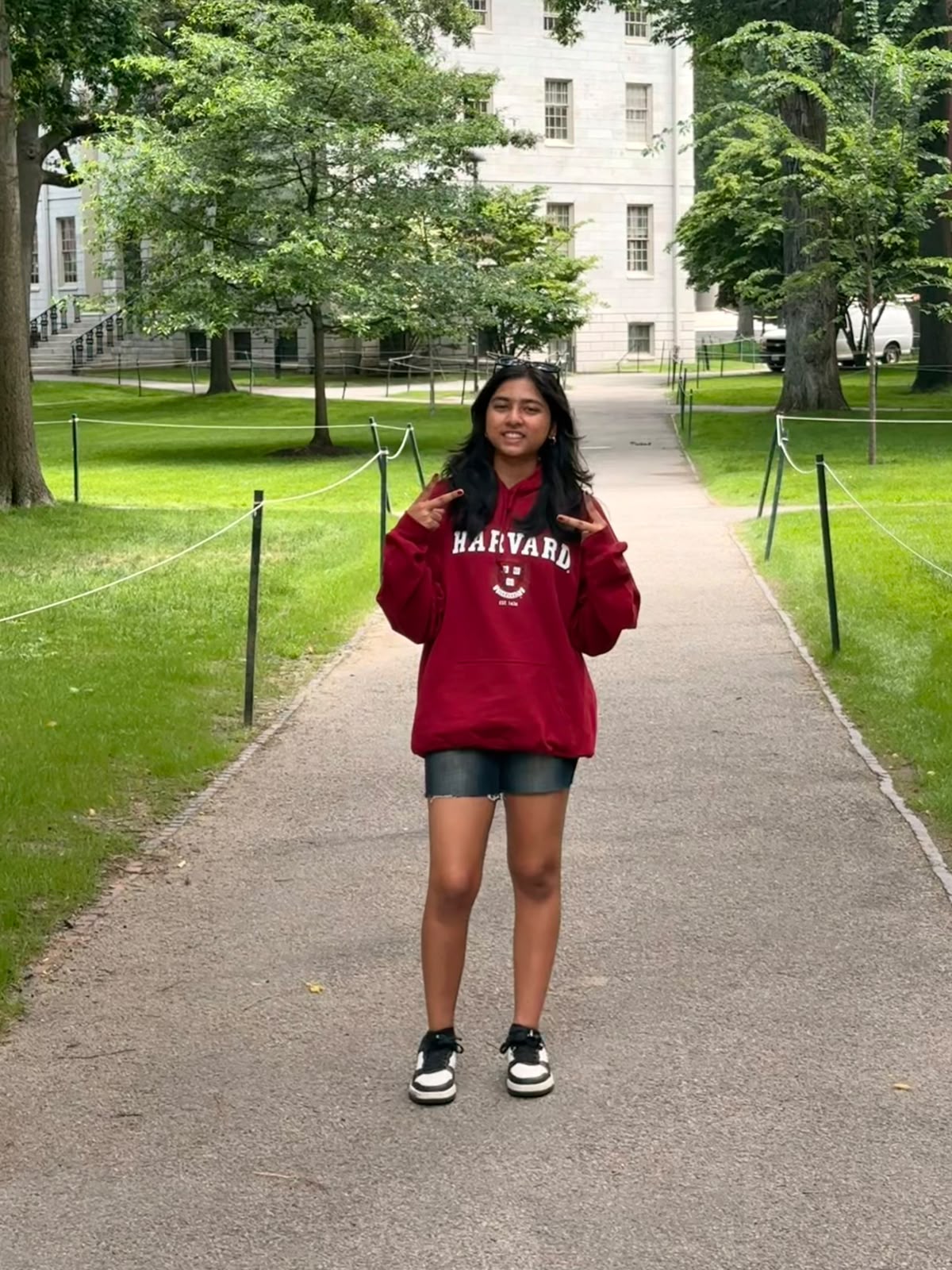
Rhea Divekar, founder of Between the Dots
⠿ Rhea Divekar
Rhea Divekar
Founder, Between the Dots

I'm Rhea Divekar, founder of Between the Dots. I'm seventeen, studying the IB Diploma Programme at Victorious Kidss Educares in Pune. I've loved writing and reading for as long as I can remember. I'm a trained Indian classical dancer in Kathak and Bharatanatyam, and I have a deep interest in neuroscience, which I hope to pursue in the future.

Age 17 IBDP · Victorious Kidss Educares, Pune Kathak & Bharatanatyam Aspiring Neuroscientist Published Author
⠿ Connect on LinkedIn ↗

Ever since I started reading, I never stopped. I don't mean reading in the everyday sense — texts, signs, the internet — I mean books. Everywhere I went as a child, there was always one in my hand, because books carried me somewhere far more serene than the world I was actually standing in.

My first book was written when I was four — terrible illustrations, twenty spelling mistakes, and a passion I couldn't yet explain. I kept writing all through childhood and my teenage years, and that love only grew. I loved how a story could carry meaning without saying it outright, how it could share what I wanted the world to know, and how it let me become more of who I am. At thirteen, I published my first novel, Eunoia of the Endless Horizon, available on Amazon worldwide — and I'm nowhere near done writing.

At some point I decided I wanted to learn Braille, so I did. It started almost on a whim, but the dedication that followed surprised even me — I spent hours, days, memorising the number codes, the letters, how they looked, how they felt under my fingers. I learned to type Braille on a slate and a Brailler, and the first thing I ever transcribed was my own book of poetry.

Over time — through research, through paying attention to the world around me — it became clear that visually impaired children simply don't have enough access to creative writing. I wanted them to feel the same spark I did with fiction as a child. So I brought together everything I loved — writing, Braille, and the belief that every child deserves a story — and built Between the Dots: a way to bring reading to those who want it, but haven't had the chance.

"I wanted visually impaired kids to feel the spark I did with fictional novels."

⠿ Rhea Divekar · Founder